



Whether it's to reach your items, bring down boxes or carry out work at height, you should choose the right tools for your needs. So what are the various types of rolling ladders?
Rolling step ladder or standard rolling ladder
The step-type rolling ladder is the most common on the market. Generally, it is built either as 1 welded unit that requires no assembly after delivery, or in several pieces, including one large section containing the steps, which are already welded, that requires a few minutes of assembly after delivery. Very often, models with fewer than 8 steps are pre-assembled and those with 8 steps or more are shipped disassembled.
These rolling ladders are for the most common uses and are not designed for working at height. Their platform is normally 2 steps deep. They also have a 60-degree incline, which lets you climb and descend facing the steps while holding the handrail. They are therefore recommended, among other things, for small loads that are not too bulky. In standard models, you will find rolling step ladders from 1 step to 16 steps, with platforms up to 144’’ high.
Cantilever ladder
Among the types of rolling and mobile ladders, the cantilever ladder is most likely the second best known, but also one of the least used. This type of rolling ladder is much more expensive to purchase and in shipping costs from origin. It allows for a much deeper platform, so working at height is safe. They also offer a 50-degree angle, which lets you descend facing forward, as on a staircase. This type of ladder is usually offered with 6 to 14 steps, with platforms from 60’’ to 140’’ high.
Rolling stairway
The rolling stairway is a rolling ladder with a 50-degree angle instead of the standard 60 degrees. This feature lets the user descend as on a regular staircase, that is, facing forward. This difference makes it possible to handle bulkier items safely. Because the angle is gentler, however, this product line takes up more floor space for the same number of steps. This type of ladder is usually offered with 4 to 16 steps, with platforms from 40’’ to 160’’ high.
Mechanic's rolling ladder
This type of ladder is generally used for upkeep and maintenance. It is equipped with wheels, and the whole ladder must be tilted to move it on its wheels. The platform is deeper than on a standard model, which allows work at height. It also comes with a removable work tray. This type of ladder is offered from 3 steps to 6 steps, with platforms from 28’’ to 57’’ high.
Tilt-and-roll ladder
The tilt-and-roll ladder, or “Tilt-N-Roll”, is equipped with wheels, and the whole ladder must be tilted to move it on its wheels. The platform is deeper than on a standard model, which allows work at height. This type of ladder is offered with 3 to 6 steps, with platforms from 27’’ to 56’’ high.
Types of rolling and mobile ladders: Trailer access rolling ladder
This type of ladder is something of a subcategory of rolling step ladders. It has chains at the top of the platform that allow access to a trailer or truck. This type of ladder is offered with 4 to 6 steps, with platforms from 37’’ to 55’’ high.
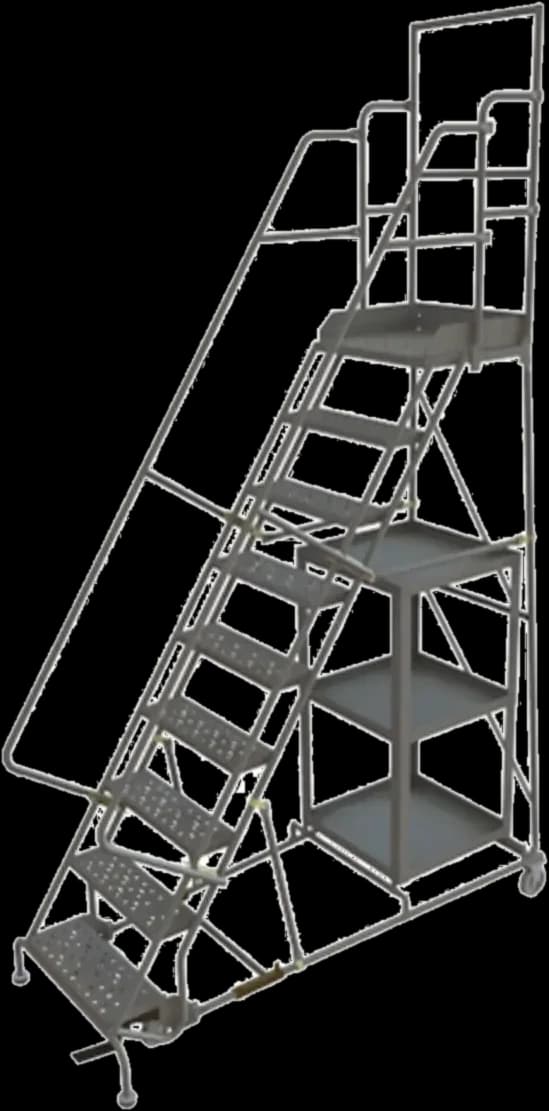
Types of rolling and mobile ladders: Stock picking ladder
The stock picking ladder has built-in shelves. There are normally 2 shelves on 6- and 7-step models and 3 on models with 8 steps or more. It is usually a special-order type.
Types of rolling and mobile ladders: Pivoting rolling ladder
The big advantage of the pivoting rolling ladder is its lateral mobility. In tighter spaces, or where sideways movement is more frequent, this type of ladder can be more useful. However, its higher purchase cost makes it less accessible, and it is less common among the types of rolling ladders found on the market.