



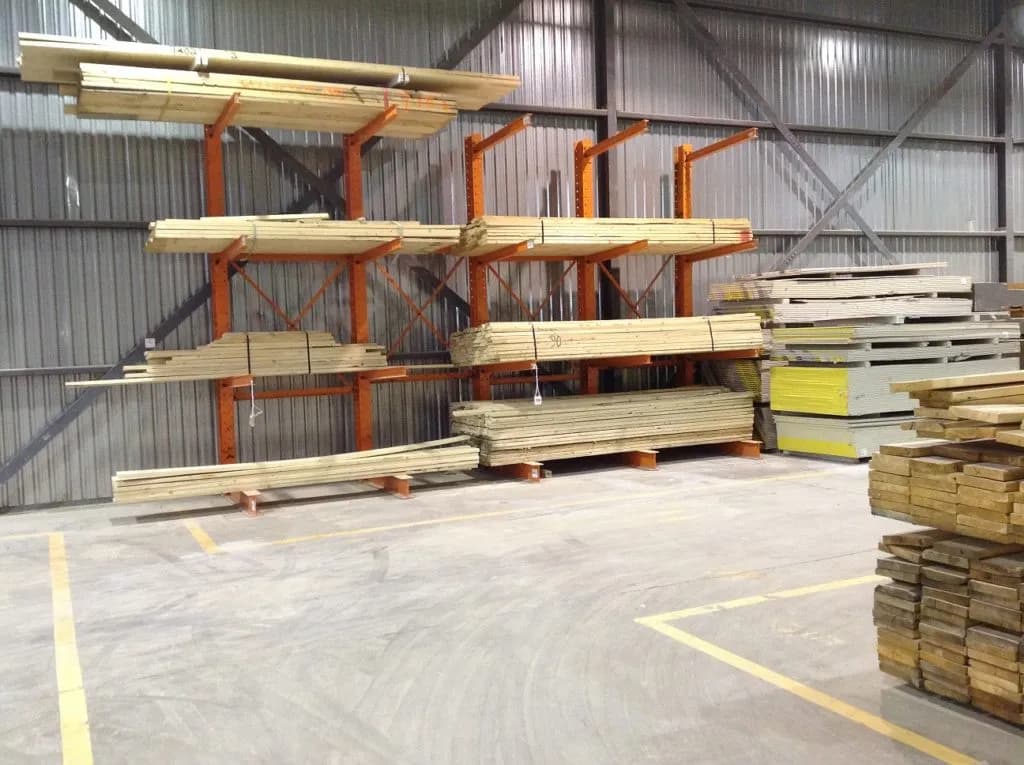
Cantilever racking
Cantilever racking is known in French as “porte-à-faux” racking. You'll find this racking most often in hardware-store lumber yards or in certain specialized sectors, such as steel beam production, for example. It is mainly used to store parts or products of greater lengths.
Cantilever racking: Dimensions
Cantilever is usually custom-built to suit needs. Height generally ranges from 8’ to 20’. The total width of a section is also usually a little smaller than the total length of your products. The goal is for the arms to support the products in the most balanced way possible. The products will therefore overhang the ends of a single rack, for example. As for the arms, the most standard range from 24’’ to 48’’, but you can request longer or shorter.
Cantilever racking: Distance between columns
The distance between columns can vary based on several criteria. The most important is undoubtedly capacity. If you have very heavy products, the load will need to be distributed over more arms and also more columns. The columns will therefore be closer together. Another criterion is obviously the length of your products. For a 4’ product versus an 8′ one, for example, the distance between the arms must be smaller. Finally, the other element to consider is the rigidity of your products. An item that tends to bend on itself will need more closely spaced supports so it doesn't sag and get damaged.
Accessories
The most common accessories on cantilever racking are the following. You can have “stoppers” at the end of your arms. These stop contents that could slide off. You can also have a roof over your cantilever. Very popular in lumber yards or for outdoor storage.